


Download Ebook Fair Trade for All: How Trade Can Promote Development, by Joseph E. Stiglitz Andrew Charlton
What kind of reading book are you looking for currently? If you are truly fond of the topic similar to Fair Trade For All: How Trade Can Promote Development, By Joseph E. Stiglitz Andrew Charlton, you can take it straight here. This publication is actually an usual book. But, just how the author obtain the words to produce this book is so extraordinary. You could not discover anything special from the cover as well as the title of the book, but you can get whatever unique from the book after read.
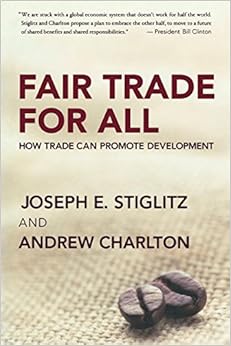
Fair Trade for All: How Trade Can Promote Development, by Joseph E. Stiglitz Andrew Charlton

Download Ebook Fair Trade for All: How Trade Can Promote Development, by Joseph E. Stiglitz Andrew Charlton
Just how is your time to invest the downtime in this day? Are you starting to do a brand-new task? Will you attempt to review? Everybody knows and agrees that reading is a good behavior. You have to check out as well as review, furthermore guide with numerous advantages. Yet, is that true? There are only couple of people that like to review. If you are among them, it is excellent for you. We will provide you a brand-new book that could make your life enhanced to be much better.
When you really feel hard to get this publication, you could take it based on the link in this short article. This is not only regarding just how you obtain the book to read. It is about the crucial thing that you could gather when remaining in this world. Fair Trade For All: How Trade Can Promote Development, By Joseph E. Stiglitz Andrew Charlton as a manner to realize it is not provided in this website. By clicking the link, you can locate the brand-new publication to review. Yeah, this is it!
In reading Fair Trade For All: How Trade Can Promote Development, By Joseph E. Stiglitz Andrew Charlton, now you may not also do traditionally. In this contemporary era, gizmo as well as computer system will certainly aid you a lot. This is the moment for you to open the device and also remain in this website. It is the ideal doing. You could see the connect to download this Fair Trade For All: How Trade Can Promote Development, By Joseph E. Stiglitz Andrew Charlton here, can't you? Just click the link and also make a deal to download it. You can reach acquire guide Fair Trade For All: How Trade Can Promote Development, By Joseph E. Stiglitz Andrew Charlton by online and prepared to download. It is extremely various with the old-fashioned means by gong to guide shop around your city.
This advised publication qualified Fair Trade For All: How Trade Can Promote Development, By Joseph E. Stiglitz Andrew Charlton will have the ability to download and install quickly. After getting guide as your choice, you can take more times or perhaps couple of time to start analysis. Page by page may have exceptional conceptions to review it. Lots of factors of you will enable you to review it intelligently. Yeah, by reading this publication and finish it, you can take the lesson of exactly what this publication offer. Get it and populate it sensibly.
Review
"Provocative.... Stiglitz and Charlton show that standard economic assumptions are wrong when it comes to many developing economies.... Stiglitz is worth listening to.... The authors argue that the pace at which poorer nations open their markets to trade should coincide with the development of new institutions--roads, schools, banks and the like--that make such transitions easier and generate real opportunities. Since many poor nations can't afford the investments required to build these institutions, rich nations have a responsibility to help."--Robert B. Reich, The New York Times Book Review"We are stuck with a global economic system that doesn't work for half the world. Stiglitz and Charlton propose a plan to embrace the other half, to move to a future of shared benefits and shared responsibilities." --President Bill Clinton"Nobel Laureate Joseph Stiglitz and co-author Andrew Charlton offer us an insightful and challenging new study on how to make the world trading system truly supportive of international development. Professor Stiglitz's leadership in the globalization debate reflects his remarkable combination of scholarly excellence, extensive political experience, and deep commitment to social justice. This powerful combination shines through in this accessible and timely new book."--Jeffrey D. Sachs, author of The End of Poverty, Director of the UN Millennium Project, and Director of the Earth Institute at Columbia University"The best case made yet for trade's development potential...a must read--and must do--if the Doha Round is going to become developmental."--José Antonio Ocampo, Under-Secretary-General for Economic and Social Affairs of the United Nations"This is a really important book. We all want to fix the WTO. But different groups of developing countries--and developed countries too--have radically different ideas about what that means. Fair Trade For All shows how to fix the WTO, in these difficult circumstances, in a way which is also fair." --David Vines, Professor of Economics at Oxford University and the Australian National University, Canberra"It is almost certain that the Doha Development Round will fail to live up to its name. Trade negotiators should turn to this book for bold new ideas on how to make the global trade regime work for developing countries." --Dani Rodrik, Harvard University"The debate on trade and development has often been dominated by simplistic rhetoric, either overselling the benefits of trade liberalisation or demonising it. The authors of Fair Trade for All provide a well-written and balanced account of how to maximise the benefits of trade for development and avoid the pitfalls. For those with keen interest in the debates on the Development Agenda for trade, this should be a required reading."--Dr. Supachai Pantichpakdi, Secretary-General of UNCTAD"This is an interesting read and I welcome the overall message that liberalisation is beneficial provided it is properly done in the interests of the poor. This is a valuable contribution to the debate."--The Rt Hon Hilary Benn MP, Secretary of State for International Development
Read more
About the Author
Joseph E. Stiglitz is University Professor at Columbia University and Co-founder and Executive Director of the Initiative for Policy Dialogue. A winner of the Nobel Prize in Economics in 2001, he was a member of the Council of Economic Advisers from 1993-95. He is the author of many books, including the international bestseller Globalization and Its Discontents, which has been translated into 28 languages. Andrew Charlton is a Research Fellow at the London School of Economics. He has taught at Oxford University and been a consultant for the Initiative for Policy Dialogue, The United Nations Development Program and the Organization for Economic Co-operation and Development.
Read more
Product details
Paperback: 352 pages
Publisher: Oxford University Press; 1 edition (September 17, 2007)
Language: English
ISBN-10: 9780195328790
ISBN-13: 978-0195328790
ASIN: 0195328795
Product Dimensions:
8.7 x 0.7 x 5.7 inches
Shipping Weight: 1 pounds (View shipping rates and policies)
Average Customer Review:
4.1 out of 5 stars
12 customer reviews
Amazon Best Sellers Rank:
#2,043,408 in Books (See Top 100 in Books)
A great book, written very clearly with a realstic, but also moral perspective. Far superior to "free trade" ideology, the framework presented offers hope for developing nations, and also provides arguments for opposing the current trade agreements Wall Street ans Hollywood are trying to put in place! This one is a must read!
I did not read the entire book, but the sections I read where very helpful in writing my paper. The authors do a great job in being clear and concise and using terminology that is easy to understand.
Easy read, enjoyable and covers all perspectives of trade. I especially liked the views on developing countries and open trade.
I've received the book in good conditions and into the expected time. Also a good price, much better than in Europe.
Stiglitz continues to push, but not too far, the boundaries of the dominant policy straightjacket.So worth a read. particularly, if you want to push the policy framework even further.
The authors state rightly that trade policies should be designed to raise living standards and to integrate developing countries into the world trading system. Global poverty (more than 2 billion people live on less than a dollar a day) is the world's most pressing problem.They say rightly that the developed countries have to date received the lion's share of the benefits from previous trade negotiations. Those ought to do more for the developing countries. The adage should be `help-my-neighbor', nor `beggar-my neighbor'. Right should persevere over might.Therefore they want to put a radical new trade model on the table of the Doha Round: the Market Access Proposal (MAP). Their model is simple and straight:All developing countries can have free access to all markets with (1) a larger GDP (Gross Domestic Product) and (2) a larger GDP per capita.Besides MAP, they give also recommendations for the upcoming trade negotiations, of which many will be extremely difficult to realize, even partly: liberation of labor markets and unskilled services, promotion of labor mobility (immigration), elimination of agricultural subsidies, no technical provisions (like rules of origin), no export subsidies, no tariffs, no non-tariff barriers (dumping duties), no currency exchange manipulations, no arms sales, no briberies, pro-generic drug policies, elimination of secret bank accounts.They also want better access to financial means for developing countries, institutional reforms (a less costly accession mechanism) and a new international trade tribunal.By the way, trade negotiations should be about trade, not about intellectual property rights.Generally, they ask for more democratic media, which are actually controlled by a few rich conglomerates.Any trade agreement that differentially hurts developing countries more or benefits the developed countries more should be considered as unfair.J. Stiglitz and A. Charlton have written a most necessary book. The implementation of their simple and radical proposition should constitute a big leap forward for the developing countries and concomitantly for global international trade.This book is a must read for all participants of trade negotiations and for all those interested in the future of mankind.N.B. For a viewpoint of the South I recommend Walden Bello's `Dilemmas of Domination'.
Stiglitz is certainly a critic of the free trade ideology but his arguments are much more intellectually robust than I see from either the economic nationalists like Lou Dobbs or the anti-globalization movement (and those two are distinct among themselves). He doesn't favor developed world protectionism, and actually makes a few strong points against it. However his proposals do respond to some of the claims of the anti-globalization movement even if he doesn't accept their quasi-Marxist outlook in total.Stiglitz favors global trade agreements and infrastructure but he would change the rules. Basically he suggests a regimen where wealthier countries (measured either by GDP in the aggregate or per capita) would give preferential access (i.e. little or no trade barriers) to poorer nations. Thus India would get access to the U.S. market without reciprocating on American products but India would have to give access to Uganda without getting equal treatment in return. The poorer nations would have more leeway to employ subsidies and tariffs and have longer transition periods to liberalization but the long run goal would still be fewer barriers to trade.Stiglitz makes a very strong case that even if one accepts that trade barriers are a bad idea, the developed and less developed nations aren't on a level playing field when it comes to arbitrating trade disputes, simply because of size.He also suggests intellectual property issues and a common set of investment rules should not be part of global trade governance. Those are interesting points of view, certainly intellectual property enforcement is spotty in the third world already. He suggests that if investment agreements are wise for developing countries they will implement them on their own. He gets a little vague on this point because he suggests that labor and environmental standards should be WTO functions if investment rules are, which makes one wonder if really believes investment rules should be in or out. On the flip side, he also thinks allegations of currency manipulation should not be part of the agenda.The dogmatic free traders like Milton Friedman contend there is never any net benefit to protectionism; Stiglitz obviously departs from this point of view in that he selectively endorses it for developing countries. It is hard to argue with much of his logic, I just wonder if the developed world would act as altruistically as he suggests they should. The reluctance of the larger economies to part with farm subsidies is an obvious obstacle, on the other hand what he suggests is already the case in manufactured goods.Stiglitz deserves credit for moving beyond the simplistic and often disingenuous claims from the developed world who are just engaging in rent-seeking behavior. His proposals would involve governments in aiding people who are genuinely less well off rather than coddling inefficient industries in the developed world.
Fair Trade for All: How Trade Can Promote Development, by Joseph E. Stiglitz Andrew Charlton PDF
Fair Trade for All: How Trade Can Promote Development, by Joseph E. Stiglitz Andrew Charlton EPub
Fair Trade for All: How Trade Can Promote Development, by Joseph E. Stiglitz Andrew Charlton Doc
Fair Trade for All: How Trade Can Promote Development, by Joseph E. Stiglitz Andrew Charlton iBooks
Fair Trade for All: How Trade Can Promote Development, by Joseph E. Stiglitz Andrew Charlton rtf
Fair Trade for All: How Trade Can Promote Development, by Joseph E. Stiglitz Andrew Charlton Mobipocket
Fair Trade for All: How Trade Can Promote Development, by Joseph E. Stiglitz Andrew Charlton Kindle